
 English
 Español
 Pусский
 Français
 Deutsch
 日本語
日本語 한국어
한국어 العربية
 Italiano
 Nederlands
 Polski
 ไทย
ไทย Türk dili
 हिन्दी
 Indonesia
 Melayu
 Tiếng Việt
 čeština
 Română
High pressure solenoid valves for rocket attitude control systems
High-pressure solenoid valves are critical components in rocket attitude control systems, where precise and reliable fluid control is essential for maintaining spacecraft orientation. These valves regulate the flow of propellants or pressurized gases to thrusters, enabling the vehicle to adjust its pitch, yaw, and roll during flight. In space environments, attitude control must be extremely accurate because even a small error can affect trajectory, stabilization, docking, or orbital positioning.A high-pressure solenoid valve operates by using an electromagnetic coil to move a valve element between open and closed positions. When an electrical signal is applied, the solenoid generates a magnetic field that actuates the internal mechanism, allowing fluid to pass through. When the signal stops, the valve returns to its default state, often through a spring or pressure-assisted design. This fast response makes solenoid valves suitable for pulse-based thrust control, where brief and repeated firings are needed to fine-tune vehicle attitude.For rocket applications, these valves must withstand demanding conditions, including extreme pressure, vibration, temperature variation, and exposure to aggressive propellants or inert gases. Materials are selected for strength, corrosion resistance, and compatibility with the working medium. Common design requirements include low leakage, short switching time, high cycle life, and stable performance over a wide temperature range. Because attitude control systems often operate in safety-critical environments, valve reliability is a top priority.In many spacecraft, solenoid valves are used in reaction control systems that feed thrusters with propellant at high pressure. The valve must open and close repeatedly with very consistent timing to ensure predictable impulse delivery. This consistency helps maintain accurate control authority and reduces uncertainty in the vehicle’s response. In some designs, multiple valves are arranged in redundant configurations to improve fault tolerance and mission reliability.Another important feature of high-pressure solenoid valves is their compact size and relatively simple control interface. They can be driven by electrical commands from onboard guidance computers, making them easy to integrate into automated control architectures. This allows the spacecraft to respond quickly to sensor data and adjust its orientation without manual intervention. The combination of speed, precision, and remote operability makes solenoid valves highly valuable in modern aerospace systems.Testing and qualification are especially rigorous for these valves. They are typically subjected to pressure proof tests, leak tests, thermal cycling, vibration tests, and long-duration endurance tests before being approved for flight use. These tests verify that the valve can function reliably under launch and space conditions. In attitude control applications, any valve malfunction could lead to loss of control, so validation is essential.In summary, high-pressure solenoid valves play a vital role in rocket attitude control systems by enabling precise, rapid, and repeatable fluid control. Their ability to operate under harsh conditions while delivering dependable performance makes them indispensable in spacecraft propulsion and stabilization systems.
Produto
Categoria:
-
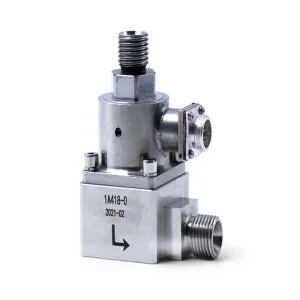
High pressure solenoid valves for rocket attitude control systems
Sua classificação: Solenoid ValveVistas: 857Número:Tempo de liberação: 2026-10-23 17:20:18Nominal diameter: DN6
Operating voltage: DC27V±3V
Connection type: M14*1.5 external thread
Notícias
Categoria:
Nenhum resultado de pesquisa!
Caso
Categoria:
Nenhum resultado de pesquisa!
Vídeo
Categoria:
Nenhum resultado de pesquisa!
Download
Categoria:
Nenhum resultado de pesquisa!
Recrutamento
Categoria:
Nenhum resultado de pesquisa!
Produtos recomendados
-
NEWS
High pressure solenoid valves for rocket attitude control systems
Saiba mais



 Whatsapp
 Telefone